
BATTERY PACK ANALYSIS
KEYWORDS: Automotive, commercial vehicle, electric vehicle, finite element analysis, NVH, durability, optimization
Key Highlights:
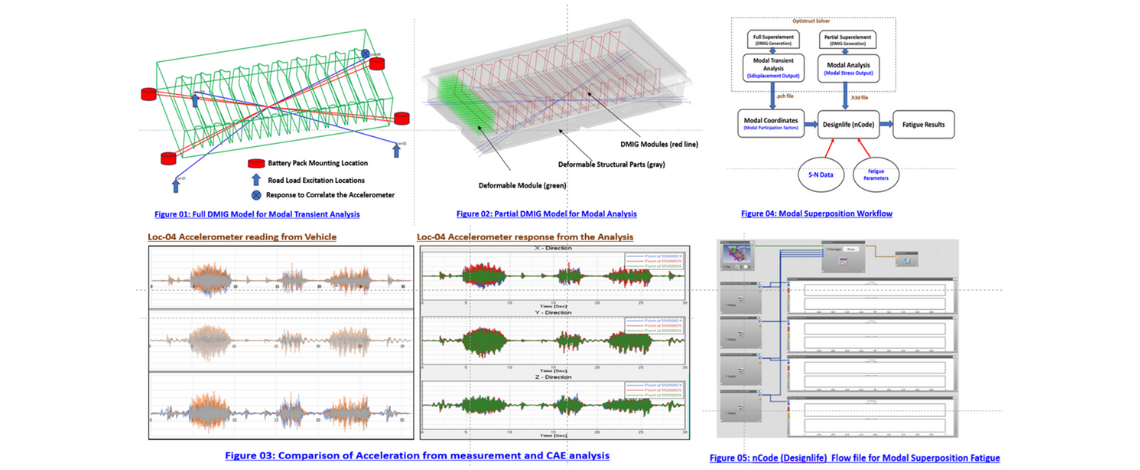
- Importance of Validation: Battery pack assemblies must be validated under real-world vibrations to ensure structural integrity, durability, and fatigue life. Accelerometer data from critical points informs simulations and shaker table testing.
- Computational Challenges & Hybrid Modeling: Full-scale CAE models are computationally intensive due to millions of nodes. A hybrid approach using finite element meshes combined with super-element modeling reduces simulation time and storage while maintaining accuracy.
- Modal Transient & Superposition Analysis: Transient FEA can be expensive for large models. Modal transient analysis with modal superposition reduces CPU time, efficiently capturing dynamic effects for fatigue evaluation while managing storage requirements.
- Super-Element Implementation: Only one battery module is modeled in detail while others are represented as super-elements. This reduces computation time to minutes, accelerates fatigue analysis in nCode, and enables faster design iterations.
- Validation & Correlation: Excitations are applied at accelerometer locations, with responses compared against test data. Strong correlation between analysis and vehicle tests confirms the FE model’s accuracy, supporting reliable fatigue and dynamic performance assessments.